

Recent Post

New Managing Director for HYAB Magneter AB

Chinese New Year 2027 - Secure your deliveries!
The Difference Between Pull Force, Holding Force, and Shear Force – A Common Misconception
Magnet components – the unsung hero of the green transition
How do you choose the perfect magnetic strength for your application?
Follow us


How does temperature affect the performance of magnets?
Published: 2026-01-15 09:25:37 • Daniel Gårdefelt
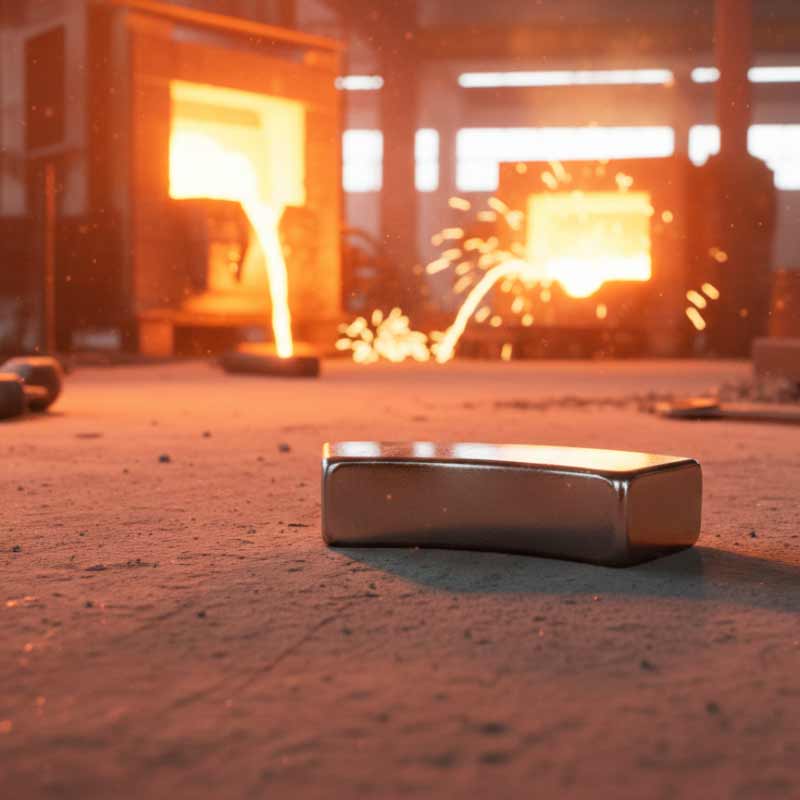
HYAB Magneter supplies magnets to most manufacturing industries in Sweden. Our magnets are therefore used in many different industrial applications where conditions vary greatly. One factor that has a significant impact on magnetic components and their performance is the temperature to which they are exposed, which often influences the type of magnet we recommend to our customers.
As the temperature rises, the atoms in the magnet begin to vibrate more, which in turn leads to a decrease in magnetic strength. If the temperature increase is within the range that the magnetic material can withstand, this is a reversible effect that recovers when the temperature drops again. If the temperature exceeds its maximum working temperature, also known as the Curie temperature, the magnet is permanently demagnetized.
We have previously reviewed different types of magnets and their strengths and weaknesses. Neodymium magnets are considered one of the stronger types of magnets, but cannot withstand high temperatures (max 80–200 °C depending on quality). Samarium-cobalt magnets are very temperature-resistant (250–350 °C) and ferrite magnets can withstand relatively high heat (250 °C), even though they are a weaker variant in terms of magnetic strength. AlNiCo magnets can also withstand very high temperatures, but they are easily demagnetized by external magnetic fields.
At low temperatures, the magnetic strength often increases slightly as atomic motion decreases. However, the risk at sub-zero temperatures, for example, is that the material becomes brittle and thus more sensitive to mechanical stress.
Does your project involve high or low temperatures, or any other demanding conditions? Contact us on +46 8 26 10 80 or [email protected] and we will be happy to tell you more about which type of magnet is best suited to your needs.